
Wire Markers For Every Application
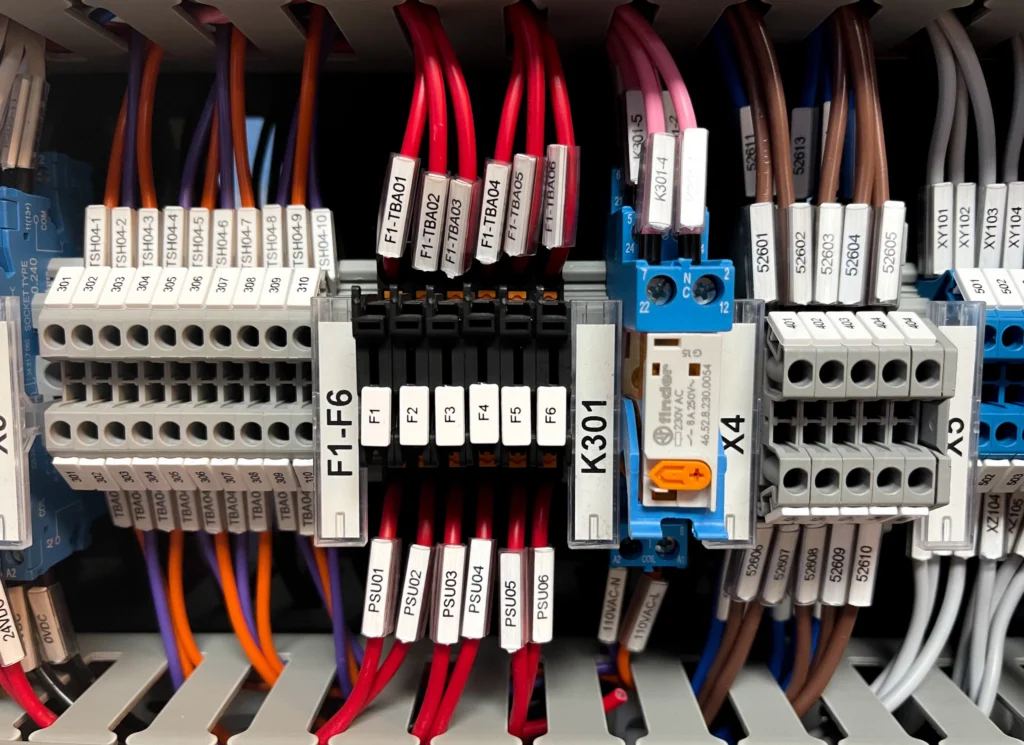
Grafoplast®® range of products to make wire marking easy and cost effective. Choose from the Grafoplast®® TRASP®® manual system or print your own with the EVOMAX thermal printer.
Why Grafoplast® for wire marking?
Professional wire marking is fundamental to electrical installation quality, safety, and long-term maintainability. Whether you’re an electrical contractor working on commercial buildings, a panel builder manufacturing control systems, an OEM integrating electrical assemblies, or a maintenance professional managing facility infrastructure, clear wire identification directly impacts your efficiency, reduces errors, and demonstrates professional craftsmanship. Unmarked wires create delays during installation, complicate troubleshooting, and increase the risk of dangerous cross-connections. Grafoplast® wire markers eliminate these problems through durable, clearly visible identification that lasts the lifetime of the installation.
The Grafoplast® TRASP® system represents decades of refinement in wire marking technology. Our exclusive dual recess sleeve design prevents the smudging, unwrapping, and degradation that plague inferior marking systems, ensuring your identification remains legible years after installation. We offer complete flexibility in how you mark wires – choose the manual TRASP® pick-and-place system for immediate, equipment-free marking, or leverage EVOMAX thermal printing for high-volume production efficiency. Many professionals maintain both capabilities, using manual marking for field modifications and service work while employing thermal printing for panel production and large projects. This dual approach ensures you always have the most efficient wire marking solution regardless of project scope, location, or timeline constraints.
Understanding Wire Marking Applications
Wire marking serves different purposes across various electrical disciplines. In control panel fabrication, wire markers identify signal paths, power distribution, and I/O connections, enabling panel builders to work from schematics efficiently and allowing commissioning technicians to verify connections against design documentation. Industrial machinery wiring relies on wire markers to trace motor controls, sensor circuits, and safety interlocks through complex cable runs where physical tracing would be impractical. Building electrical systems use wire markers in electrical rooms and riser closets to identify branch circuits, emergency systems, and communications infrastructure, ensuring electricians can quickly locate specific circuits during additions or modifications.
The applications extend beyond traditional electrical work. Instrumentation and process control systems depend on wire markers to identify analog signals, digital communications, and power supplies in environments where misidentification could compromise safety or production. Automotive and aerospace harness manufacturers use wire markers to ensure assembly accuracy and facilitate troubleshooting of electrical systems. Marine and railway applications require specialised halogen-free wire markers that meet fire safety regulations for enclosed passenger spaces. Data centres employ wire markers to manage power distribution alongside network cabling, while renewable energy installations mark DC circuits, inverter connections, and monitoring systems where voltage levels and polarity identification prevent dangerous errors.